
Strategy9 min read

How Long Does SEO Take? What Moves When, and Why

A metric-by-metric timeline for SEO and AI visibility, and why the honest answer is not one number.

why seo takes time

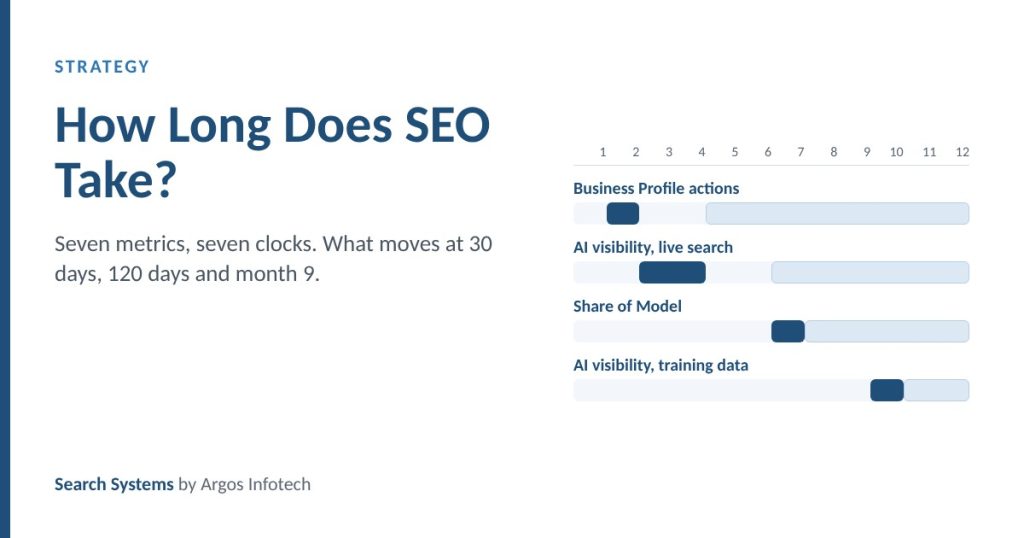
SEO does not have a single timeline, because different results run on different clocks. Google Business Profile actions and corrections to what AI assistants get wrong can show first measurable movement in 30 to 60 days. AI visibility on questions answered through live search typically moves in 60 to 120 days. Visibility that depends on what AI models learned in training is not expected before month 9. Full maturity takes about 12 months.

Anyone who gives you one number for “how long SEO takes” is averaging very different processes. This guide breaks them apart, explains why each takes the time it does, and shows what you should see along the way.
Why is there no single answer?

Search visibility now comes from several inputs, and each one updates at its own speed. Google re-crawls and re-ranks pages continuously. Business Profile changes take effect within days. AI assistants that run a live search can pick up an improved page as soon as it ranks. But what an AI model learned in training only changes when the model is retrained, which happens on multi-month cycles.

Four inputs, four clocks
Business Profile editsDaysChanges appear once Google reviews them.
Search rankingsWeeks to monthsCrawl, index, evaluate, re-rank against competitors.
AI answers from live search60 to 120 daysPick up a page once it ranks.
AI answers from training dataMonth 9 onwardChange only when the model is retrained.
Slow is not broken. Each input updates at its own speed. One number for "how long SEO takes" averages all four.

So the useful question is not “how long does SEO take?” It is “how long does each metric take to move, and what drives it?”

What moves when?

These are the ranges we use in every proposal, roadmap and report.

Metric First measurable movement Expected maturity
Google Business Profile actions (calls, direction requests) 30 to 60 days Month 4 onward
Hallucination Rate (how often AI gets your facts wrong) 30 to 60 days, once fact pages and schema are in place Below 5 percent by month 4
AI visibility on questions answered through live search 60 to 120 days Month 6 onward
Citation Source Mix (where AI answers get their sources) Month 4 Continuous improvement
Share of Model on high-intent questions Month 6 Month 12
Knowledge Graph recognition Checked quarterly, movement typical at month 6 Month 9 with focused entity work
AI visibility on questions answered from training data Month 9 onward Month 12 onward
What moves when, months 1 to 12
Month123456789101112
Business Profile actionsCalls and direction requests
Hallucination RateAI fact errors, target below 5%
AI visibility, live searchRetrieval-driven questions
Citation Source MixWhere AI gets its sources
Knowledge GraphEntity recognition, checked quarterly
Share of ModelHigh-intent questions
AI visibility, training dataWhat models learned
First measurable movementToward expected maturity (fading bar: continues past month 12)
Seven metrics, seven clocks. Business Profile and accuracy work registers first. Anything that depends on what models learned in training is not expected before month 9.

We do not publish a separate timeline for keyword rankings, because rankings depend almost entirely on how strong your competitors are. Ranking progress shows up inside these metrics: pages that rank are what AI assistants retrieve when they search.

Why does search take months at all?

Search engines need time to process change

When a page is published or improved, Google and Bing have to discover it, crawl it, index it, evaluate it against competing pages and then adjust rankings as signals accumulate. That cycle runs continuously, but meaningful ranking shifts on competitive queries usually take weeks to months, not days.

Authority accumulates slowly

Search engines and AI models trust businesses that other sources talk about: links from relevant sites, mentions in publications, reviews and consistent directory listings. Each of those has to be earned one at a time. A month of authority cannot be built in a week.

Rankings are relative

Your competitors are working too. Rankings measure your position against theirs, so progress has to outpace their progress. Catching up to a competitor with years of content and reviews takes longer than holding a position you already have.

AI models learn on a delay

What an AI model knows about your business from training reflects the web as it was before its last training run. Mentions earned today typically take six to nine months or longer to appear in answers that come from training data. That is why we do not expect training-data metrics to move before month 9, and why earned coverage starts early.

The first 12 months
Months 1 to 3Foundation
  • Founder interview, onboarding
  • Business Profile and Apple Business Connect
  • Schema, fixes, company facts pages
  • Baseline AI visibility and accuracy audit
  • Citation and directory cleanup
Can start to moveBusiness Profile actionsHallucination Rate
Months 4 to 6Content and authority
  • Regular content, posts, review requests
  • First citation source analysis
  • Mid-point review, tactic shift
  • Earned coverage outreach
  • First business review
Can start to moveAI visibility, live searchCitation Source MixShare of Model (first movement)
Months 7 to 12Measurement maturity
  • Earned coverage reaches training data
  • Deeper coverage where citations come from
  • More comparison pages and reviews
Can start to moveAI visibility, training data (month 9+)Share of Model maturity (month 12)
Work first, measurement follows. Each phase sets up the metrics that move in the next one.

What happens in months 1 to 3?

The first three months build the foundation and establish the baseline every later result is measured against.

  • Onboarding and a recorded founder interview that becomes the factual basis for the About page.
  • Google Business Profile and Apple Business Connect optimized.
  • Initial schema, technical fixes and a set of Source-of-Truth pages, including a plain company facts page.
  • Baseline AI visibility measurement and an AI accuracy audit across the major assistants.
  • Citation and directory cleanup so name, address and phone match everywhere.
  • First FAQ content and first published articles.

What you should see: a baseline report, a list of what AI gets wrong with the fix for each, and fixes going live. What you should not expect yet: a jump in traffic or AI visibility. Business Profile actions and AI accuracy are the first metrics able to move.

What happens in months 4 to 6?

Months 4 to 6 are when content and authority work starts to register in the measurements.

  • Regular content publishing, Google Posts and review requests running.
  • The first citation source analysis: which sources AI answers cite for your category.
  • A mid-point strategy review that shifts effort toward what the measurement shows is working.
  • Outreach for earned coverage in the sources AI cites most for your category.
  • The first business review, with every metric labeled for how consistently it has moved.

What you should see: AI visibility moving on questions answered through live search, a shift in which sources AI cites, and first movement in Share of Model by month 6. Each carries a confidence label, so one good month is not mistaken for a trend.

What happens in months 7 to 12?

Earned coverage placed in the first six months starts to reach the training data of AI models. The work continues at the same pace: sustaining content, deepening the earned coverage that is producing citations, expanding comparison pages and growing reviews. From month 9, AI visibility on questions answered from training data can begin to move. Share of Model typically matures around month 12.

What makes SEO faster or slower?

What changes the pace

Faster

  • A less competitive market or niche
  • An established domain with authority
  • Pages already on page two or three
  • A technically sound site
  • Local Business Profile work

Slower

  • A crowded category, such as personal injury or CRM
  • A brand-new domain
  • Indexing or rendering problems
  • Recovery from a Google penalty
  • A thin content library
Your starting point matters. Two businesses on the same plan can move at very different speeds.

How can you tell it is working before the big results arrive?

Look for early indicators that the foundation is taking hold:

  • AI assistants getting fewer facts about your business wrong.
  • New and updated pages indexed in Google Search Console, with impressions rising.
  • Calls and direction requests from your Business Profile trending up.
  • Review count and recency growing.
  • AI visibility scores on live-search questions improving across cycles.
  • More AI citations pointing to your own site or earned coverage.

If AI visibility is flat after 90 days, that is a signal to review, not to wait. The usual checks are which sources AI is citing instead of you, gaps in your content, and missing comparison coverage.

Why do we not promise traffic or revenue growth?

Because no one can isolate it honestly at the scale of a single business. Buyers often see a brand in an AI answer, then search for it by name later, so analytics credits the visit to branded search or Direct. Most AI platforms do not pass referrer data consistently. And bots can inflate raw Direct traffic, which is why we report engaged sessions only.

What we do instead: we report our own measurements with confidence labels, and place your platform data and your sales records next to them as context, without claiming one caused the other. Be skeptical of any timeline that promises traffic will double by month 12.

How results are reported
Argos-measuredOur six metrics, each with a confidence label
Platform-reportedSearch Console, GA4 engaged sessions, Business Profile
Client-reportedLead and sale counts from your CRM
Buyer-stated"How did you hear about us?" answers
Not measuredShown as a gap, never left blank
Shown side by side, never as a funnel. No line from our work to your revenue.
Context, not credit. Each source is labeled for what it is. Nothing is presented as proof that our work caused a traffic or revenue change.

What should you expect from an SEO partner?

  • Published timelines, by metric, before you sign. Anyone promising page one rankings in 30 days is guessing or using tactics that risk penalties.
  • Reports that lead with measurement, showing where you appear, the trend and what changed, not just a list of tasks completed.
  • A clear explanation of what is being done and why.
  • Tactic changes driven by data. If something is not moving the metrics, it should be reduced or cut.
  • Honesty about bad news, including flat months, competitor gains and algorithm changes.

What can you do while you wait?

  • Run other channels. Paid search, email and social can produce leads while SEO builds.
  • Feed the process. Send photos, approve content quickly, and share case study details. Slow approvals slow results.
  • Ask how buyers found you. Add “How did you hear about us?” to your forms, with AI assistants as an option. It is the most direct evidence of AI-assisted discovery available.
  • Ask every customer for a review. Reviews help rankings and shape what AI says about you.
  • Check monthly, not daily. Rankings and AI answers fluctuate day to day. Monthly trends are what matter.

Is the wait worth it?

Content, reviews and earned mentions keep working after the month they are produced. Paid clicks stop when the budget stops. That difference is why SEO is planned on a 12-month horizon, and why training-data results are not expected before month 9.

Request a free AI Visibility Audit

If you want to know where you stand before committing, It shows how AI assistants describe your business today and what they get wrong, delivered within 5 business days. For the full method, read what Search Systems Engineering is, or see what actually works in AI search optimization.

Request the audit

Frequently asked questions

Can SEO show results in 30 days?

Some metrics can. Google Business Profile actions and corrections to what AI assistants get wrong can show first measurable movement in 30 to 60 days. Competitive rankings and AI visibility take longer: 60 to 120 days for live-search questions and month 9 or later for training-data questions.

When should I worry that SEO is not working?

If early indicators are flat after about 90 days, review the strategy. Check which sources AI answers cite instead of you, where your content has gaps and whether comparison pages exist. Flat early indicators call for a change in tactics, not more waiting.

Why are SEO engagements planned for 12 months?

Because the slowest input, what AI models learn in training, is not expected to move before month 9, and Share of Model on high-intent questions typically matures around month 12. A shorter horizon ends before the earned coverage placed early can show up.

How long does it take to show up in ChatGPT?

It depends on whether ChatGPT searches for the answer. For questions where it runs a live search, pages that rank can be picked up in 60 to 120 days. For answers drawn from training data, expect month 9 or later, because models are retrained on multi-month cycles.

About the author

Manish Patel

Founder and CEO, Argos Infotech

Manish Patel is the founder and CEO of Argos Infotech, a custom software and search company founded in 2005. He has led Argos's SEO work since 2012 and oversees Search Systems, its search measurement and AI visibility service.