AI Visibility11 min read

AI Search Optimization: What Actually Works

A practical guide to AEO for businesses, built on what can be measured and honest about what cannot.

Ai search optimization guide

AI search optimization, also called answer engine optimization (AEO) or generative engine optimization (GEO), is the work of making a business findable, accurately described and citable when people ask AI assistants such as ChatGPT, Gemini, Perplexity and Google AI Overviews for recommendations. Most of it is SEO, digital PR and entity accuracy done well. What is genuinely new is the need to measure AI answers directly.

This guide covers how AI assistants build answers, the work that moves visibility, the tactics that do not, and how to measure results without overstating them.
How do AI assistants decide what to say about a business?

AI assistants build answers from two inputs. The first is training data: what the model learned from the web before its training cutoff. The second is live retrieval: a search the assistant runs at the moment of the question, whose results it summarizes. The balance between the two differs by platform and by question.

  • ChatGPT answers many questions from training data alone. A Semrush clickstream analysis reported in April 2026 found a live web search on about 34.5 percent of queries, down from about 46 percent in late 2024. When it searches, it has historically relied heavily on Bing alongside other sources.
  • Perplexity is retrieval-dominant. It searches on nearly every question and shows its sources prominently.
  • Google AI Overviews, AI Mode and Gemini draw on Google’s own index.
  • Microsoft Copilot uses Bing.
Where each assistant gets its answers
ChatGPTTraining dataBing and other web sourcesAnswers many questions without searching
PerplexityOwn crawlOther search indexesRetrieval-dominant: searches for most answers
Google AI Overviews, AI Mode, GeminiGoogle index
Microsoft CopilotBing index
Pages that rank in Google and Bing are retrievable by all four.
Search indexes sit underneath AI search. That is why ranking in Google and Bing remains the foundation of AI visibility. Platform mixes change, so we re-test rather than assume.

The practical consequence: a business needs two kinds of work. Owned content that ranks in Google and Bing feeds live retrieval. Mentions in authoritative third-party sources feed training data. Every defensible AEO tactic supports one of the two.

Is AEO different from SEO?

Mostly, no. A page that ranks in traditional search is more likely to be retrieved when an assistant runs a search, and the authority that earns rankings also earns mentions. Treating AEO as a separate discipline usually means paying twice for the same work, or paying for tactics with no evidence behind them.

Two things are different. First, content structure matters more, because AI systems extract passages rather than send readers to whole pages. Second, AI answers vary from run to run and rarely send trackable traffic, so they have to be tested directly rather than inferred from analytics

What actually moves AI visibility?

1. Rank pages that answer buyer questions

Start from the questions buyers actually ask, then build or improve the page that answers each one. Bottom- and middle-funnel questions come first, because they carry purchase intent and are cited most often.

Which questions to answer first
Top of funnel"What is [category]?"Educational guides. Often answered from training data, so citation rates are low.
Middle of funnel Priority"What works best for [use case]?"Use-case and comparison content. Moderate citation rate, large opportunity.
Bottom of funnel Priority"Best [solution] for [scenario]" or "[Brand A] vs [Brand B]"Comparison pages and vendor evaluation content. Highest commercial intent.
Start at the bottom. Middle and bottom-of-funnel questions carry purchase intent and are cited most often. Top-of-funnel content supports authority.

2. Structure content so AI can extract it

Structure measurably affects citation. Princeton’s GEO research (Aggarwal et al., KDD 2024) found that adding statistics with cited sources lifted visibility in generative engine answers by up to 40 percent. A 2026 study (arXiv:2603.29979) held content constant, varied only structure across six generative engines, and found a consistent 17.3 percent improvement.

  • Answer first. Put the core answer in the first sentence of the page and of each section.
  • Question headings that match how buyers phrase the question.
  • Definitions that begin with the term being defined.
  • Modular paragraphs of roughly 40 to 60 words that make sense if extracted alone.
  • Specific numbers, dates and named examples instead of general claims.
  • Lists for steps, tables for comparisons.
The same idea, written two ways
Before

"Our firm has extensive experience helping clients with personal injury matters."

No answerVague claimNothing to quote
After

"A personal injury lawyer represents people injured through someone else's negligence and pursues compensation for medical bills, lost wages and pain and suffering. Most work on contingency, taking a share of the settlement instead of an hourly fee."

Answer firstDefines the termSpecificStands alone
Extractable beats impressive. An AI system lifts passages, not pages. The second version can be quoted whole and still make sense.

3. Add something no model already knows

A page that only restates what every competitor says gives a model nothing new to cite. Each piece should contain at least one element of information gain: a data point you own, a named and verifiable example, an expert’s judgment on a hard question, or a comparison only you are positioned to make. The test is simple: what does this page contain that no model could produce by averaging public sources?

4. Earn mentions in the sources models learn from

Training data reflects how often authoritative sources mention a brand. Earned coverage is prioritized by source type: reference sources such as Wikidata, major news and trade publications, review platforms such as G2, Capterra and Yelp, community platforms such as Reddit and Quora, then professional directories. Expect this work to take six to nine months or longer to show up in AI answers, because models retrain on multi-month cycles.

Earned coverage, by source tier
Tier 1Reference sourcesWikipedia, WikidataDefines the entity
Tier 2Major and trade publicationsNews outlets, industry trade pressTraining data corpus, high authority
Tier 3Review platformsG2, Capterra, TrustRadius, YelpCited for comparisons and reputation
Tier 4Community platformsReddit, Quora, YouTubeReal-time retrieval
Tier 5Professional directoriesLinkedIn, Crunchbase, industry directoriesConfirms the entity
Tiers 1 and 2 first. One placement in a major or trade publication can do more than many low-tier listings. Expect six to nine months or longer before it shows in AI answers.

5. Make sure AI describes you correctly

Accuracy comes before visibility. If an assistant names you but gets your services, location or pricing wrong, the mention can cost you the lead. Consistent name, address and phone across profiles, a complete Google Business Profile and Apple Business Connect listing, a Wikidata entry where appropriate, and Organization schema all help engines identify the business correctly.

We also build a set of Source-of-Truth pages on the client’s own site, including a plain company facts page with dated, verifiable facts and no marketing copy. When an audit finds an AI error, the fix starts there: correct the canonical fact, update the schema, then retest at the next cycle. Error rates frequently improve within 30 to 60 days.

6. Build genuine reviews

Review platforms are among the sources AI answers cite for comparison and reputation questions. Ask every customer, make leaving a review easy, and respond to all of them. Never buy, fake or incentivize reviews: it breaks platform rules, and in the US the FTC’s rule on fake reviews took effect in October 2024.

Does schema markup help with AI search?

Indirectly. Language models do not read JSON-LD while they generate an answer. Schema does enrich the entity data that Google and Bing hold about a business, and those indexes feed AI surfaces. It also supports rich results in traditional search. That makes schema worth implementing correctly, but it is not a lever that makes an assistant recommend you.

Two current limits are worth knowing. Google stopped showing FAQ rich results for all sites on May 7, 2026, although it still uses FAQPage markup to understand pages. And Google does not show star ratings for reviews a business publishes about itself on its own Organization or LocalBusiness markup. Mark up only what is visible on the page.

A clean LocalBusiness example for a fictional firm:

{
  "@context": "https://schema.org",
  "@type": "LegalService",
  "@id": "https://www.example.com/#business",
  "name": "Example Law Group",
  "url": "https://www.example.com/",
  "telephone": "+1-713-555-0100",
  "address": {
    "@type": "PostalAddress",
    "streetAddress": "100 Main Street, Suite 200",
    "addressLocality": "Houston",
    "addressRegion": "TX",
    "postalCode": "77002",
    "addressCountry": "US"
  },
  "areaServed": "Houston, TX",
  "sameAs": [
    "https://www.linkedin.com/company/example-law-group"
  ]
}

What does not work?

These tactics are widely sold. We do not sell or use them, for the reasons below.

Tactic Why it does not work
An llms.txt file as a visibility tactic Crawler log studies show low fetch rates by the bots that drive citations and no reliable link to citation frequency.
Markdown copies of pages for AI Negligible crawler requests in testing. Risks competing with the original page.
Speakable schema No evidence voice or AI assistants use it to select content.
“Summarize with AI” buttons that inject instructions Microsoft’s security team classifies hidden instructions in these buttons as AI Recommendation Poisoning (February 2026).
Self-promotional “best of” listicles at scale Google’s review and helpful content systems demote them, and search losses carry into AI citations.
Generic AI-written long-form Adds no information gain, so there is nothing new for a model to cite.
Rewriting for fluency alone The Princeton GEO research found negligible citation improvement from fluency changes alone.
Fake accounts, fake reviews, mass promotional posting Detection causes damage that outlasts any short-term gain.
Paid placements disguised as editorial Increasingly detected and filtered by search engines and AI surfaces.
Wikipedia articles for businesses that are not notable Leads to deletion and reputational damage. Wikidata is the right first step.

How do you measure AI visibility?

AI visibility is measured by testing the questions buyers ask, on a fixed method, every cycle. Analytics alone cannot show it.

How AI visibility is measured
  1. Build the question setSearch Console, sales calls, Business Profile terms, forums, buyer answers
  2. Test in clean sessionsLogged out, no history, from your market
  3. Run three timesPer question, per platform, timestamped
  4. Score 1 to 5Same scale every cycle
  5. Check the factsSeven accuracy questions, every location
  6. Record the sourcesWhich sites each answer cites
Same method, every cycle. Each result then gets a confidence label, so one good month is never mistaken for a trend.

Build the question set

The set of test questions comes from real buyer language: Google Search Console queries rewritten as questions, Google Business Profile search terms, questions prospects ask your sales team, competitor content, Reddit and forum threads, and what new customers say they asked an AI assistant. Add a “How did you hear about us?” question with AI assistants as an option to your forms.

Test under controlled conditions

Each question is run three times per platform in a clean session with no history or personalization, logged out where possible, from the business’s market area. Every run is timestamped and the platform version recorded, so one cycle can be compared with the next.

Score every answer the same way

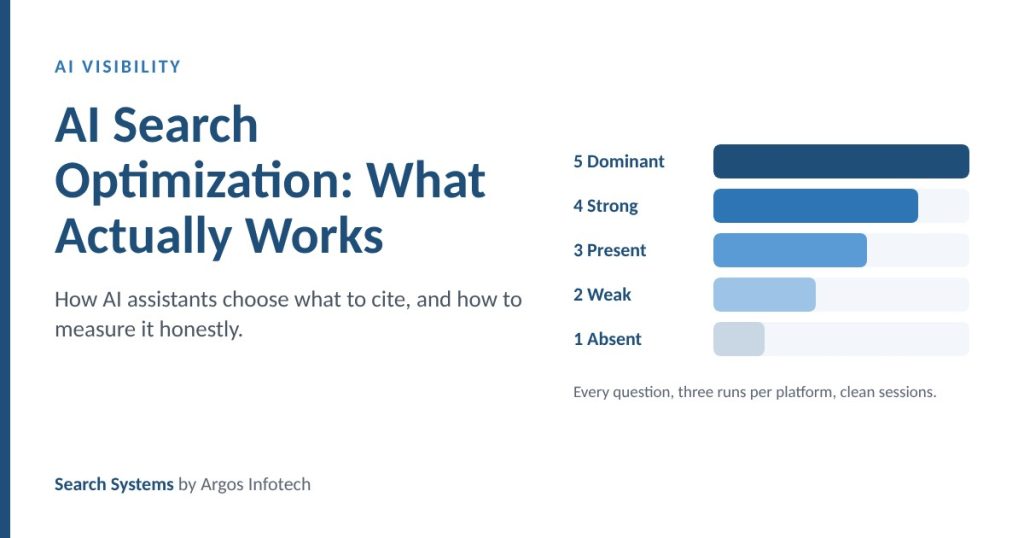
Score Meaning
5. Dominant Recommended as the top option, named first, or singled out as the best fit.
4. Strong Among the top three options mentioned, described positively.
3. Present Mentioned, but not prominently. Part of a longer list or described weakly.
2. Weak The category or competitors are mentioned. The brand is absent or referenced only indirectly.
1. Absent No mention of the brand or its content.

Check accuracy, not just presence

Run seven fact-check questions on every platform: what the company does, where it is located, what it offers, whether it fits a stated use case, who leads the category, how it compares with a named competitor, and what its reputation is. For multi-location businesses, run the location question for every location.

Record where answers come from

For every answer with citations, record each cited source and its type: your site, competitor pages, review platforms, community threads, publications or directories. That source mix shows where effort will count.

Finally, label every metric for consistency: Stable after three or more cycles in one direction, Improving after one or two, Volatile when results swing, and Insufficient sample when there is not enough data. One good month is not a trend.

Why can't AI search traffic be measured precisely?

Most AI platforms do not pass referrer data consistently, so AI referral traffic in analytics is a floor, not a ceiling. Buyers also see a brand in an AI answer, then search for it by name later, which analytics records as branded or Direct traffic.

Raw Direct traffic can also be inflated by bots, so only engaged sessions are a fair comparison. This is why AI answers are tested directly, and why no honest provider should claim its work caused a traffic change.

How long does AI search optimization take?

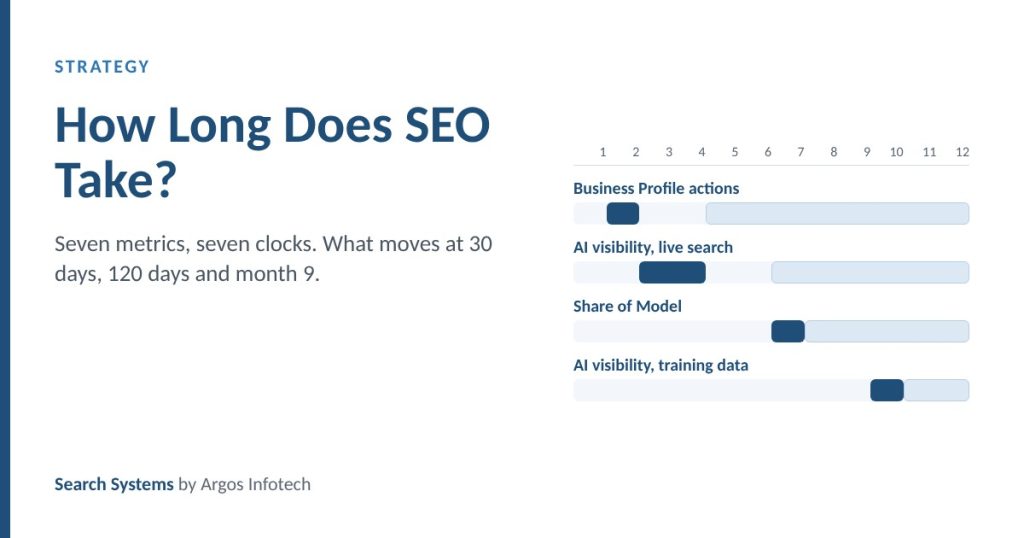
Accuracy fixes backed by Source-of-Truth pages often show first movement in 30 to 60 days. Visibility on questions answered through live search typically moves in 60 to 120 days. Visibility that depends on training data is not expected before month 9. The full breakdown is in our SEO timeline guide.

Where should a business start?

  1. Get a baseline. Test how AI assistants describe and rank your business today.
  2. Fix the facts. Correct anything AI gets wrong at the source: your website facts page, Business Profile and directory listings.
  3. Restructure your highest-intent pages. Answer first, question headings, specific numbers, comparison tables.
  4. Start earned coverage early. It is the slowest input, so it needs the longest runway.
  5. Measure every month and change the tactic mix based on what moves.

Request a free AI Visibility Audit

We run the seven-category accuracy check across the major AI assistants and deliver the findings, with business risk and fix path, within 5 business days. For the full method, read what Search Systems Engineering is.

Request the audit

Frequently asked questions

Can I pay to get my business recommended by ChatGPT?

There is no way to buy a place in ChatGPT’s organic answers. Recommendations come from what the model learned in training and what it finds when it searches. The reliable route is ranking content, earned mentions in authoritative sources and accurate entity information.


Should I add an llms.txt file to my website?

It does no harm, but do not pay for it as an AI visibility tactic. Studies of AI crawler logs show low fetch rates by the bots that drive citations and no reliable link between llms.txt and how often a site is cited.


How do I know if AI assistants are getting my business wrong?

Ask them, systematically. Run the same fact-check questions about your services, locations, pricing and reputation on each major assistant, three times each in a clean session, and record every incorrect statement and the source it appears to come from.

Is AEO replacing SEO?

No. AI assistants that search the web draw on search indexes, so ranking well in Google and Bing remains the foundation. AEO adds content structure for extraction and direct measurement of AI answers on top of SEO, rather than replacing it.

About the author

Manish Patel

Founder and CEO, Argos Infotech

Manish Patel is the founder and CEO of Argos Infotech, a custom software and search company founded in 2005. He has led Argos's SEO work since 2012 and oversees Search Systems, its search measurement and AI visibility service.