Search Systems Engineering is an approach to search visibility that tests how a brand appears across Google Search, Google Maps, Apple Maps, AI assistants and review platforms every month, then directs SEO, digital PR, entity and content work at whatever the measurement shows is moving. Measurement is the product. The execution follows the evidence.
What Is Search Systems Engineering?
How we measure visibility across Google, Maps and AI assistants, and why most of the work is still SEO.
Why does search visibility need a systems approach now?
Buyers now meet a business in several places before they act. A buyer might see a brand in a Google AI Overview, hear it named in a ChatGPT answer, read about it in a Reddit thread, then search the brand name directly. Analytics records one branded visit and loses every step that came before it.
We call that hidden journey dark search. It is the main reason keyword ranking reports undercount visibility. The only honest way to know whether a brand appears where buyers look is to test those surfaces directly, with the same method every cycle. That testing is the core of Search Systems Engineering.
- Google AI OverviewNot recorded
- ChatGPT answerNot recorded
- Reddit threadNot recorded
- Maps listingNot recorded
- Searches brand nameRecorded
What analytics sees:one branded visit, no record of the four touchpoints that led to it
Is AI search a separate discipline from SEO?
No. Most AI answers are built from two inputs: what the model learned from the web during training, and what it retrieves live from search indexes when it runs a search. Google’s AI Overviews and AI Mode draw on Google’s index. Microsoft Copilot uses Bing. Perplexity combines its own crawl with other indexes. ChatGPT search has historically relied heavily on Bing alongside other sources.
A page that ranks well in traditional search is therefore more likely to be retrievable when an AI assistant runs a search. That is why we say plainly that most of what is marketed as AEO or GEO is SEO, digital PR and entity hygiene with new vocabulary. The part that is usually missing is systematic measurement of the AI answers themselves.
Training data
What the model learned from the web before its last training run.
Fed by earned coverage: publications, review platforms, communities, directories
Changes when the model is retrained, on multi-month cycles
Live retrieval
What the assistant finds when it runs a search at the moment of the question.
Fed by owned content: your pages that rank in Google and Bing
Changes as soon as a better page ranks
AI answerThe mix differs by platform and by question
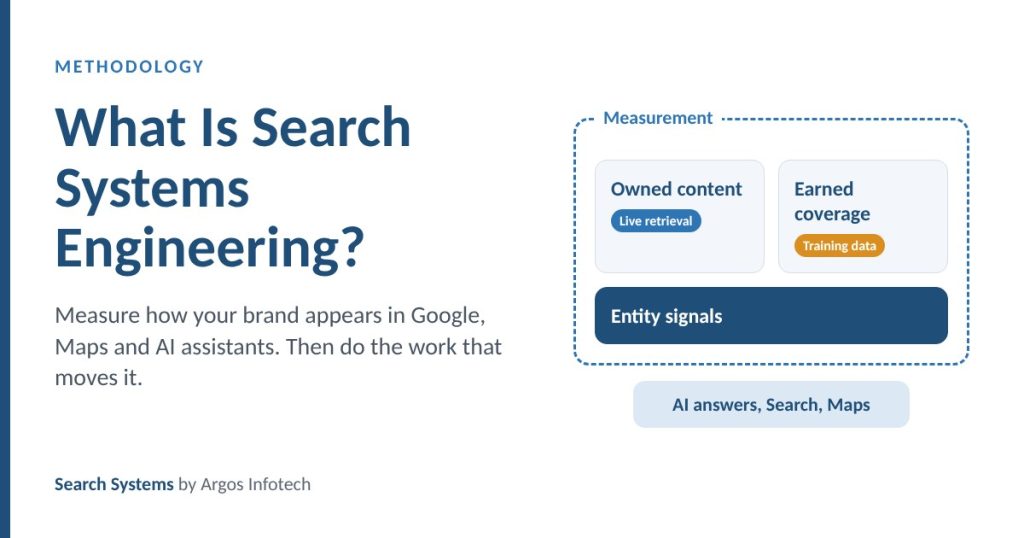
What are the four layers of Search Systems Engineering?
Search Systems Engineering organizes all work into four layers. Two feed the inputs AI answers are built from, one helps engines identify the business correctly, and one measures the result.
Measurement: tests every layer, every cycle
Owned content
Service, location, comparison and FAQ pages that rank in Google and Bing.
Feeds live retrievalEarned coverage
Mentions in publications, review platforms and communities.
Feeds training dataEntity signals
Business Profile, Apple Business Connect, Wikidata, Organization schema and consistent profiles, so engines identify the right business.
| Layer | What it does | Typical work |
|---|---|---|
| Owned content | Feeds live retrieval. Pages that rank in Google and Bing can be cited when an assistant searches. | Technical SEO, service and location pages, comparison pages, FAQs |
| Earned coverage | Feeds training data. Repeated mentions in authoritative sources teach models to name the brand. | Digital PR, review platforms, community participation |
| Entity signals | Helps search engines and models identify the business and avoid confusing it with similar names. | Google Business Profile, Apple Business Connect, Wikidata, Organization schema, consistent profiles |
| Measurement | Tests how the brand appears and shows what is moving. | AI visibility testing, entity accuracy audits, citation source analysis |
Every layer applies to every business. The weighting changes. A dental practice leans on entity signals and its Google Business Profile. A software company leans on owned content, comparison pages and review platforms such as G2 and Capterra.
What does Search Systems Engineering measure?
Search Systems Engineering tracks six metrics. Each one answers a different question about how a business shows up.
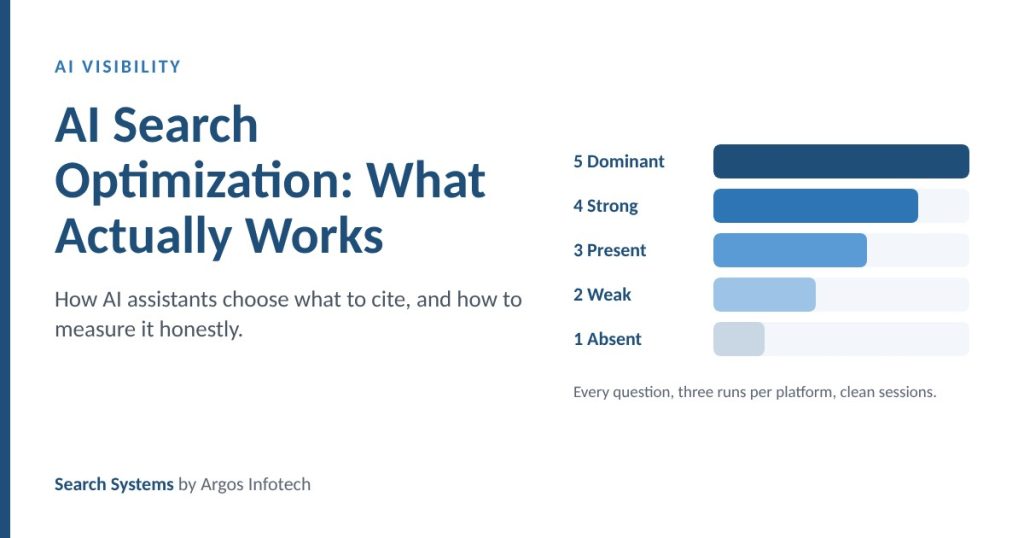
- AI Visibility Score: where the brand appears across a defined set of real buyer questions, scored 1 (absent) to 5 (dominant) per question and averaged over three runs per AI platform.
- Share of Model: the percentage of tested AI responses that cite or recommend the brand.
- Citation Source Mix: where AI answers get their citations: the brand’s own site, earned coverage, community platforms, review sites or competitor pages.
- Hallucination Rate: the share of fact-check questions where an AI assistant states something incorrect about the business.
- Google Business Profile actions (local businesses): calls and direction requests generated by the profile.
- Knowledge Graph score: a quarterly check of how Google’s Knowledge Graph recognizes the brand as an entity.
5 Dominant
4 Strong
3 Present
2 Weak
1 Absent
Illustration, one question on one platform:Run 1 4Run 2 4Run 3 3Score 3.7
Every reported metric carries a confidence label: Stable, Improving, Volatile or Insufficient sample. AI answers change from one run to the next, so a single good month is not a trend. The label tells you how consistently a number has moved. It does not claim to explain why it moved.
Stable
Three or more cycles in one direction, low run-to-run variance.
Improving
One or two cycles of positive movement. Not yet a trend.
Volatile
Direction keeps changing. No strategy is anchored to it.
Insufficient sample
Too few cycles or a recent change. Nothing is concluded yet.
How is this different from a tactic-first SEO engagement?
A tactic-first engagement sells the same package every month. Search Systems Engineering sets the tactic mix with an audit, then changes it when measurement shows what is and is not working.
| Tactic-first approach | Search Systems Engineering |
|---|---|
| Fixed package of tactics every month | Tactic mix set by an audit and adjusted as evidence accumulates |
| Reports lead with deliverables and keyword rankings | Reports lead with where the brand appears, the trend and what changed |
| AI visibility claimed, or ignored | AI answers tested on a fixed method: clean sessions, three runs per question, recorded location and platform |
| Traffic and lead gains credited to the agency | No claim that the work caused traffic, lead or revenue changes it cannot isolate |
| Loose timeline promises | Published ranges for when each metric can first move |
Why is it called engineering?
Engineers measure, change something, and measure again. They accept evidence over preference. In search, that means a tactic the measurement shows is not moving the metrics gets reduced or cut, even when it is popular. Platform features change every few months. The underlying system of search indexes, trusted sources, entity signals and reviews changes slowly.
Engineering does not mean guaranteed outcomes. AI responses are non-deterministic: the same question can produce different answers on different runs. Engineering here means a documented, repeatable way to measure that variation and act only on movement that holds up across cycles.
What does Search Systems Engineering not promise?
We publish what we will not promise, because each of these is either unmeasurable or outside anyone’s control.
- Specific rankings or positions on AI platforms. Their responses are non-deterministic.
- Traffic numbers from AI platforms. Most do not pass referrer data consistently, so reported AI referral traffic is a floor, not a ceiling.
- Citation rates above the baseline we measure at the start.
- Movement in what AI models learned in training within the first nine months.
- Removal of competitor mentions from AI answers.
- That our work caused a change in your traffic, leads or revenue. At single-business scale that effect cannot be isolated, so we do not claim it.
If a ranking guarantee is a requirement, Search Systems Engineering is not the right fit, and we will say so before an engagement starts.
Who is Search Systems Engineering for?
It fits businesses that have outgrown keyword reports and want to know how they appear across every surface buyers use. The work runs on three tracks.
- Local: law firms, medical and dental practices, contractors, restaurants and retailers. The primary measure is Google Business Profile actions. See Local.
- National and SaaS: software products, e-commerce brands and national consultancies. The primary measure is Share of Model on high-intent questions such as “best [category] for [use case]”. See National / SaaS.
- Hybrid: franchises and multi-market firms that need both location visibility and brand authority. See Hybrid.
Not sure which applies? Our guide to local SEO vs national SEO walks through the test.
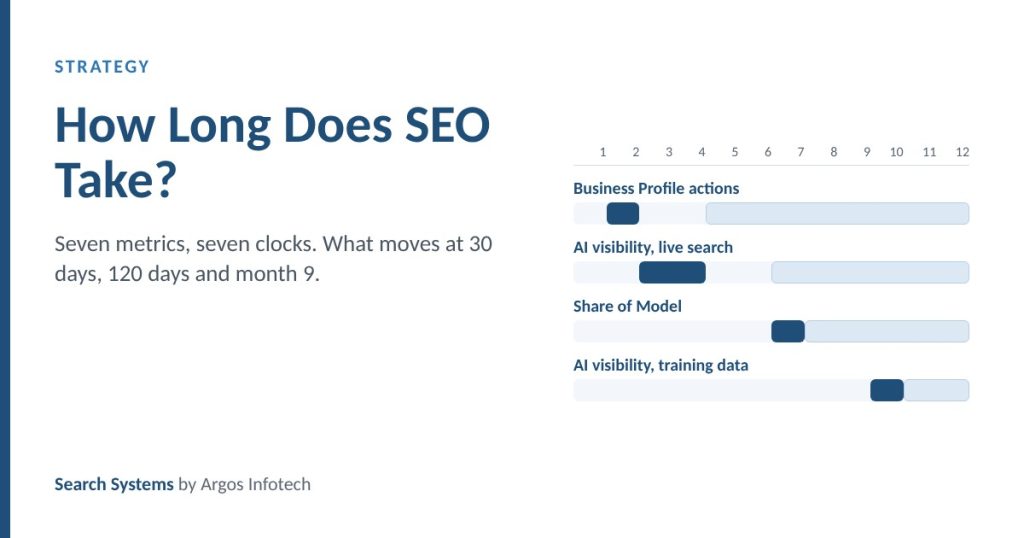
How long before anything moves?
Different metrics move on different clocks. Google Business Profile actions and AI accuracy fixes typically show first measurable movement in 30 to 60 days. AI visibility on questions answered through live search typically moves in 60 to 120 days. Visibility that depends on what models learned in training is not expected before month 9. Our SEO timeline guide covers each metric.
Month123456789101112
Business Profile actionsCalls and direction requests
Hallucination RateAI fact errors, target below 5%
AI visibility, live searchRetrieval-driven questions
Citation Source MixWhere AI gets its sources
Knowledge GraphEntity recognition, checked quarterly
Share of ModelHigh-intent questions
AI visibility, training dataWhat models learned
First measurable movementToward expected maturity (fading bar: continues past month 12)
How do you get started?
Start with a baseline: how AI assistants describe your business today and where they get it wrong. Our AI Visibility Audit tests seven question types: what you do, where you are, what you offer, whether you fit a buyer’s use case, how you compare in your category, how you compare head to head, and what your reputation looks like. Each finding comes with the business risk and the fix path.
Business description
What does [company] do?
Location
Where is [company] located?
Services or products
What does [company] offer?
Use-case fit
Is [company] a good option for [use case]?
Category competition
Who are the best [category] companies in [market]?
Head to head
[Company] vs [competitor]
Reputation
What are reviews of [company] like?
Free for your business
Request the auditRequest a free AI Visibility Audit
The report is delivered within 5 business days, with an optional walkthrough call.
Frequently asked questions
Is Search Systems Engineering the same as AEO or GEO?
It covers the same AI surfaces, but it does not treat AI search as a separate discipline. Most AI answers come from training data and live search retrieval, so the work is mostly SEO, digital PR and entity hygiene. The difference is that AI answers are measured directly every cycle.
Does schema markup make AI assistants recommend a business?
Not directly. Language models do not read JSON-LD when they generate an answer. Schema helps Google and Bing understand a business as an entity, which can feed AI surfaces indirectly, and it supports rich results. We implement schema for those reasons, not as a primary AI visibility lever.
How often is AI visibility tested?
At least monthly, and every two weeks on Scale plans. Each test uses clean sessions with no history, three runs per question per platform, and a recorded location, date and platform version, so results can be compared from one cycle to the next.
Can Search Systems Engineering guarantee rankings in ChatGPT or Google?
No. AI responses are non-deterministic and rankings depend on competitors. We commit to continuous measurement, honest reporting and execution against the highest-leverage work the measurement reveals, not to numerical outcomes the measurement is designed to discover.