
Strategy8 min read

A one-question test, the measures that matter for each, and when you need both.

A one-question test, the measures that matter for each, and when you need both.

local seo vs national seo

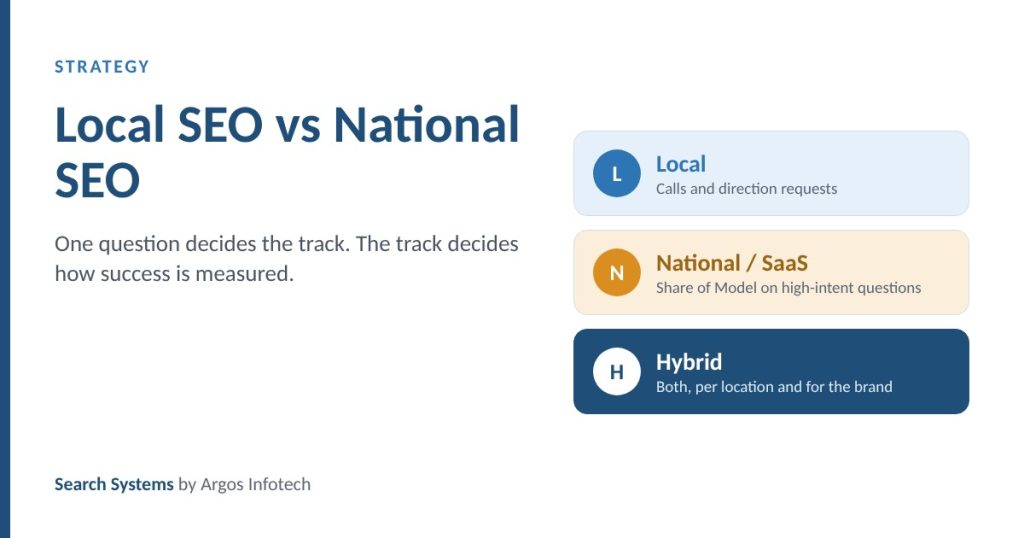
You need local SEO if customers must be inside a service area to buy from you, national SEO if location does not limit who you serve, and both if you run physical locations and also compete for buyers researching your category nationally. The right choice depends on how your customers search, not on the size of your business.

Choosing wrong is expensive. Local and national SEO target different search behavior, rely on different platforms and are measured by different outcomes. A business on the wrong track can produce good-looking reports and very few customers.
What is local SEO?

Local SEO is the work of appearing when someone searches for a service nearby, either with “near me”, a city name, or simply from a phone in your area. Google ranks local results on relevance, distance and prominence. You can influence relevance and prominence. You cannot change distance.

Local SEO focuses on:

  • Google Business Profile: the listing that appears in Google Maps and the local pack of three results. Our Business Profile guide covers it field by field.
  • Apple Business Connect: the equivalent listing for Apple Maps and Siri.
  • Location and service pages: website pages for each location or service area.
  • Citations: consistent name, address and phone (NAP) across directories.
  • Reviews: volume, recency and response on Google and industry platforms.

The primary outcome measure for local SEO is Google Business Profile actions: calls and direction requests. Website sessions matter, but they are secondary for a business whose customers often call straight from the map.

What is national SEO?

National SEO is the work of appearing when someone researches a category, compares solutions or looks for alternatives, with no location in the question. A buyer searching “best CRM for small business” or “HubSpot vs Salesforce” is a national search. Where the vendor is located rarely matters.

National SEO focuses on:

  • Category pages: content that defines and leads a product category.
  • Comparison pages: a dedicated, factual page for each major competitor.
  • Use-case pages: worked examples for each buyer scenario.
  • Review platforms: G2, Capterra and TrustRadius profiles and review volume.
  • Earned coverage: mentions in trade and industry publications.
  • Entity profiles: Wikidata, Crunchbase and LinkedIn Company Page.

The primary outcome measure for national SEO is Share of Model on high-intent questions: the percentage of tested AI answers that recommend or cite the brand when a buyer asks which product to choose.

How do local and national SEO differ?

Factor Local SEO National SEO
Search intent Location-based (“near me”, city names) Category-based (product types, comparisons)
Primary surface Google Business Profile and Maps Website, review platforms, publications
Competition Businesses in your service area Category competitors everywhere
Entity anchors Google Business Profile, Apple Business Connect, local directories Wikidata, Crunchbase, LinkedIn, G2 and Capterra
Typical AI question “Who is a good family lawyer near me?” “What is the best email marketing platform?”
Primary outcome measure Google Business Profile calls and direction requests Share of Model on high-intent questions
What the searches look like

Local searches

dentist near meemergency plumber 75001best pizza in brooklynpersonal injury lawyer houston

"Who is a good family lawyer in my area?"

National searches

best CRM for small businesshubspot vs salesforceproject management software featuresasana alternatives

"What is the best email marketing platform?"

Read your own search terms. If your Search Console and Business Profile queries look like the left column, you are local. If they look like the right, you are national.

Which one does my business need?

Ask one question: would a buyer in another state ever become your customer? If not, you need local SEO. If location never limits who you serve, you need national SEO. If you have locations customers visit and also sell to buyers anywhere, you need both.

The one-question test
Would a buyer in another state ever become your customer?
No
Local SEOPrimary measure: Business Profile calls and direction requests
Yes
Do customers also visit a location, or receive service on site?
Yes
HybridBoth measures, per location and for the brand
No
National / SaaSPrimary measure: Share of Model on high-intent questions
Two questions, three tracks. Location decides the track. The track decides what success is measured by.

You need local SEO if customers come to you, or you go to them

  • Medical practices, dental offices and veterinary clinics
  • Law firms serving specific jurisdictions
  • Restaurants, retail stores and fitness studios
  • Home service contractors such as plumbing, HVAC and electrical
  • Auto repair shops, salons and spas

You need national SEO if location does not limit who you serve

  • SaaS companies and software products
  • E-commerce businesses that ship nationwide
  • Online services and platforms
  • National consultancies and agencies

You need both (hybrid) if you have locations and a national brand

  • Franchises with multiple locations
  • Professional services firms with regional offices
  • Healthcare groups with multiple facilities
  • Software companies with regional offices that buyers visit

Each track has its own plan and measures: Local, National / SaaS and Hybrid.

What does hybrid SEO involve?

Hybrid SEO runs both tracks at once, with one strategy. Each location needs its own Google Business Profile, location page and local citations. The brand needs category content, comparison coverage and national authority. Schema connects them: each location is marked up as a LocalBusiness linked to the parent Organization, so search engines treat the locations as one brand.

How a hybrid brand is structured
BrandOrganization schema, category content, comparison pages, national coverage
Location ABusiness ProfileLocation pageLocalBusiness schemaAI accuracy check
Location BBusiness ProfileLocation pageLocalBusiness schemaAI accuracy check
Location CBusiness ProfileLocation pageLocalBusiness schemaAI accuracy check
One brand, many entities. Schema links every location to the parent organization. AI accuracy is checked for each location, because assistants can confuse branches.

Multi-location brands face one AI risk that single-location businesses do not: location confusion. An AI assistant may give the wrong branch’s address or hours, or merge two locations. That is why we run AI accuracy checks for every location separately, rather than once for the brand.

What are the most common mistakes?

A national business doing local SEO

A SaaS company optimizing for “project management software austin” is targeting a search its buyers rarely make. The fix: build category and comparison pages, grow review volume on G2 and Capterra, and answer the questions buyers ask when choosing between products.

A local business doing national SEO

A plumber writing articles on “how plumbing works” may attract readers in other states who will never call. The fix: put the effort into the Google Business Profile, local citations, reviews and service pages built around “[service] in [city]” searches.

A hybrid business doing only one

A law firm with five offices doing only local SEO never builds firm-wide authority. Doing only national SEO leaves individual offices missing from map results. The fix: brand content builds the authority that supports every location page, and each location page captures its own local demand.

How do AI assistants handle local and national questions?

AI assistants that run a live search tend to draw on different sources for each type of question. For local questions, answers often draw on Business Profile data, local directories, reviews and location pages. For national questions, they draw more on category content, comparison pages, review platforms and industry publications.

Sources AI answers tend to draw on

Local questions

  • Business Profile data
  • Local directories
  • Reviews and ratings
  • Location pages
  • Local publications

National questions

  • Category content
  • Comparison pages
  • G2, Capterra, TrustRadius
  • Industry publications
  • Community threads
A starting hypothesis, not a rule. The real mix varies by assistant and by question, so we record the cited sources for every question we test.

The mix varies by assistant and changes over time, so we do not assume it. For every question we test, we record which sources the answer cites. That citation source analysis shows where effort will count for your category, instead of relying on a general rule.

How should success be measured on each track?

Local: Google Business Profile calls and direction requests first. Then AI visibility on location-specific questions, Apple Business Connect performance, citation accuracy and the share of AI answers that get your location facts wrong.

National and SaaS: Share of Model on high-intent questions first. Then G2 and Capterra rating and review velocity, how often your comparison pages are cited, and whether your technical content is indexed.

Hybrid: both sets, reported per location and for the brand.

On every track, website traffic is reported as engaged sessions only, because bot traffic can inflate raw visit counts. We place traffic and lead figures next to our measurements as context. We do not claim our work caused them.

What drives the cost of each approach?

Local SEO cost scales with the number of locations, and the cost per location falls as locations are added because much of the work is shared. National SEO cost scales with competition: a crowded category with many competitors to track needs more measurement and more content. Hybrid combines both.

On any track, the meaningful difference between plans is measurement scope: how often AI answers are tested, how many AI assistants are covered and how closely competitors are tracked.

Four questions to decide

  1. Where are your customers? A specific area points to local. Everywhere points to national. Both points to hybrid.
  2. How do they search? “Near me” and city searches point to local. Category and product searches point to national.
  3. What influences their choice? Maps, local directories and local reviews point to local. G2, Capterra and trade publications point to national.
  4. Do customers visit you or receive service at a location? If yes, you need at least some local SEO.

Most businesses fall clearly on one side. Franchises, multi-office firms and software companies with regional offices usually need hybrid.

Request a free AI Visibility Audit

to see how AI assistants describe your business today, location by location. Delivered within 5 business days. For the method behind it, read what Search Systems Engineering is.

Request the audit

Frequently asked questions

Can a local business rank nationally?

It can, but it rarely helps. National rankings bring readers from outside the service area who cannot become customers. A local business gets more value from its Google Business Profile, reviews, local citations and service pages built around the cities it serves.

Does a SaaS company need a Google Business Profile?

Only if it has an office customers or candidates visit. The profile can support branded searches and entity recognition, but it is not a primary growth channel for a software company. Category pages, comparison pages and review platforms matter more.

Is hybrid SEO just local and national SEO added together?

The work is both sets, but it runs as one strategy. Brand content supports every location page, schema links each location to the parent organization, and AI accuracy checks run for every location because assistants can confuse branches.

What is the main metric for local SEO?

Google Business Profile actions, meaning calls and direction requests. Many local customers act straight from the map without visiting the website, so profile actions are a closer measure of demand than website sessions.

About the author

Manish Patel

Founder and CEO, Argos Infotech

Manish Patel is the founder and CEO of Argos Infotech, a custom software and search company founded in 2005. He has led Argos's SEO work since 2012 and oversees Search Systems, its search measurement and AI visibility service.